
Last Updated: November 12, 2026
Quick Summary
ADAS recalibration is the procedure that adjusts or re-aligns the cameras, radar and other sensors behind driver assistance features so they read the road accurately. It is commonly needed after windshield replacement, since many sensors sit behind the glass, and it restores the alignment the manufacturer designed around.
- A camera aimed a few degrees off can misjudge lane markings or distance to traffic ahead.
- Static calibration uses fixed targets placed at manufacturer-specified distances and heights in a controlled bay.
- Dynamic calibration relies on driving at a set speed on roads with visible lane markings.
- A routine that reports complete is not the same as one that passed; check the calibration values.
- Keep the scan report with your service records, since it documents the work if a feature misbehaves later.
Table of Contents
- What ADAS Recalibration Means and Why It Matters
- How ADAS Sensors and Cameras Work Together
- When ADAS Recalibration Is Required
- Static ADAS Calibration: The Target-Based Method
- Dynamic ADAS Calibration: The On-Road Method
- How Long ADAS Calibration Takes and What to Expect
- Booking Your ADAS Recalibration at Titan Auto Glass
- Frequently Asked Questions
What ADAS Recalibration Means and Why It Matters
ADAS recalibration is a specialized service for vehicle owners, and the process starts with a simple idea: the cameras and sensors that run your lane keeping, automatic emergency braking and adaptive cruise control only work correctly when they are aimed precisely. ADAS recalibration is the procedure that restores that alignment after a repair, replacement or change that disturbs it.
ADAS recalibration is the process of adjusting or re-aligning the cameras, radar and other sensors that power a vehicle’s driver assistance features so they read the road accurately. Many of those sensors sit behind the windshield, so a glass replacement is one of the most common reasons a recalibration is needed.
Why does it matter? A camera that is aimed a few degrees off can misjudge lane markings or the distance to a vehicle ahead. The system may then warn at the wrong moment or fail to brake when it should. Recalibration brings the sensors back to the reference the manufacturer designed around, so the features do what the owner expects.
How ADAS Sensors and Cameras Work Together
Modern vehicles rarely rely on a single sensor. Explore the ADAS features and sensor coverage on our Richardson page to see which systems may be active on your vehicle. A windshield-mounted camera typically reads lane lines, traffic signs and vehicles ahead. Radar units in the front bumper measure distance and closing speed, and ultrasonic sensors in the bumpers handle close-range parking tasks. The vehicle’s control module combines these inputs to decide what each feature should do.
Because the inputs are fused, a small error in one sensor can affect several features at once. A camera aimed slightly left may cause the lane keeping system to steer the car toward the center line while the adaptive cruise control still reads the radar correctly. The mismatch can be hard for a driver to notice until the system behaves oddly on the highway.
This is why recalibration is treated as a system-level procedure rather than a single adjustment. The technician checks how the sensors relate to one another and to the vehicle’s position, not only whether one camera looks straight.
When ADAS Recalibration Is Required
Recalibration is commonly needed after windshield replacement, particularly when the camera bracket or mounting is removed or the glass is changed. Read more about why ADAS re-calibration matters after new glass. It can also be triggered by collision repairs, suspension or ride height changes, wheel alignment work, and sensor or bumper replacement. Some owners discover the need only after a dashboard warning light appears.
Check the manufacturer’s procedure for your make, model and year, since requirements vary. Some vehicles call for a calibration after any glass work that touches the camera, while others specify it only for certain repairs. A reputable shop will review the repair and the vehicle’s service information before deciding.
Watch out: a windshield can be installed correctly and the cameras still be off. If the warning light stays on or a feature behaves oddly after glass work, have the system checked rather than assuming the job is complete.
Static ADAS Calibration: The Target-Based Method
Static calibration is performed in a controlled workspace where the vehicle stays parked and the system measures against fixed references. See a windshield replacement and recalibration from start to finish to picture the target-based procedure.
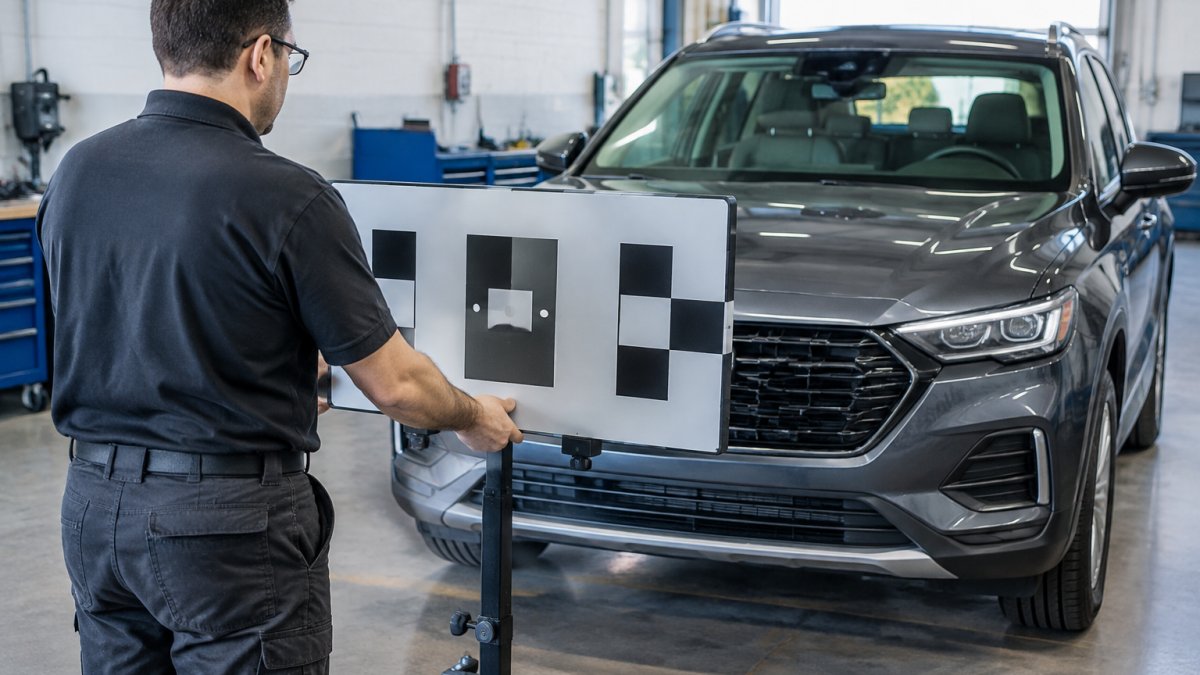
The workspace itself is part of the procedure. A calibration bay generally needs clear space in front of the vehicle, a level surface, and controlled lighting so reflections do not confuse the camera.
A typical static sequence looks like this:
- Run a pre-scan to record existing fault codes, module software versions and sensor status before any work begins.
- Confirm the vehicle’s ride height, tire pressure and wheel alignment, and check that the battery holds a stable voltage, a low battery is one of the most common reasons a routine fails partway through.
- Measure and place the calibration targets according to the manufacturer’s diagram, using a tape measure and laser level rather than eyeballing the distance.
- Start the calibration routine with the scan tool and let the sensors read the targets; the tool will report progress and any step that does not pass.
- Run a post-scan to confirm the system reports successful calibration, clear any stored codes, and verify that no related modules still show faults.
Target types vary by system. Camera-based lane keeping and automatic emergency braking usually rely on a large patterned board placed at a set distance and height in front of the vehicle. Radar units in the front bumper often use a metal reflector or corner reflector aimed at the sensor’s axis.
Watch out: a routine that reports “complete” is not the same as a routine that passed. If the scan tool shows a calibration value outside the manufacturer’s tolerance, or if a related module still logs a fault, the procedure must be repeated rather than signed off.
Static calibration is also where most failures surface. Misplaced targets, a bay that is too short, glare from an open bay door, a weak battery or a vehicle that is not sitting level are the usual culprits. A shop that repeats the routine without checking those conditions will often get the same failure twice.
The static method follows a fixed sequence of steps, and the conditions at each stage determine whether the routine passes.
| Step | What to do | Time or frequency |
|---|---|---|
| Pre-scan | Record fault codes, software versions and sensor status | Before any work begins |
| Check vehicle | Confirm ride height, tire pressure, alignment and stable battery voltage | Before calibration starts |
| Place targets | Position targets using manufacturer diagram, tape measure and laser level | Per manufacturer diagram |
| Run routine | Start calibration with scan tool and let sensors read targets | Tool reports progress |
| Post-scan | Confirm success, clear stored codes and check related modules | After calibration completes |
Dynamic ADAS Calibration: The On-Road Method
Dynamic calibration relies on driving rather than targets. The system learns its alignment while the vehicle travels at a specified speed on roads with visible lane markings, often for several minutes. Some manufacturers require a combination of static and dynamic steps, and some use dynamic calibration only as a final check.
Conditions matter. Dry weather, clear lane lines and steady speed help the system complete the routine. Heavy rain, glare or faded markings can prevent completion, which is why dynamic calibration is scheduled carefully rather than done whenever the car is driven.
How Long ADAS Calibration Takes and What to Expect
Duration depends on the method, the vehicle and whether the shop has to correct a condition first. A static-only procedure is often completed within one visit, while a dynamic step adds driving time afterward.
Several factors move the timeline:
- Method. Static-only jobs finish in the bay; jobs that require a dynamic road test add driving time on top.
- Vehicle. Some makes require a single camera calibration; others require camera, radar and sometimes a 360-degree camera routine in sequence.
- Conditions. A bay that is too short, a battery that will not hold voltage, or weather that prevents a road test can push the job to a second visit.
- Repair scope. If the glass work also disturbed a bracket or the camera mounting, the technician may need to correct the mounting before calibration can pass.
Before the appointment, tell the shop about any warning lights, recent repairs or aftermarket accessories such as a dash camera mounted near the mirror. Remove heavy cargo that would change ride height. If the vehicle has a recently replaced battery or a known charging issue, mention it, a weak battery is a frequent cause of a routine that will not complete.
During the work, the technician will usually run a pre-scan, perform the calibration, and run a post-scan. Afterward, you should receive a printed or digital scan report. Keep any scan report you receive with your service records, since it documents the work if a feature behaves oddly later.
If a warning light remains on after the job, contact the shop promptly. Calibration can fail when targets are misplaced, lighting is poor, the battery is weak or road-test conditions are wrong, and a failed routine should be repeated rather than ignored. Ask the shop whether the failure was a setup issue or a hardware issue, because a sensor that will not calibrate may need replacement rather than another attempt.
Booking Your ADAS Recalibration at Titan Auto Glass
If your vehicle needs ADAS recalibration after a windshield replacement or other repair, Titan Auto Glass provides ADAS re-calibration, and our certified technicians specialize in this work. Review buy now, pay later financing options before you book. We use quality parts and adhesives for the glass work that often triggers the calibration.
To schedule, request a quote for your windshield replacement and ADAS recalibration. Find the Titan Auto Glass Allen location and its ADAS service details. Our family-owned business stands behind its work, and our warranty covers up to one year.
Get started with Titan Auto Glass today and drive with confidence that your safety systems are working as designed.
Frequently Asked Questions
What is the ADAS recalibration process?
ADAS recalibration is the procedure that realigns the cameras and sensors behind your windshield so they read the road accurately. After glass replacement or certain collision repairs, the camera’s aim can shift even slightly. A technician first scans the vehicle for fault codes, then performs either a static calibration using targets placed at measured distances, a dynamic calibration by driving on marked roads, or both, as the manufacturer specifies. A post-scan confirms the systems are working.
When is ADAS recalibration required after windshield service?
Recalibration is generally required when a windshield with a mounted camera is replaced or removed, when the camera bracket is disturbed, or when a collision repair affects sensor mounting points or suspension geometry. Most manufacturers publish procedures that state when calibration is mandatory. A diagnostic scan before and after the job helps determine whether the camera system needs to be recalibrated for your specific vehicle.
What is the difference between static and dynamic ADAS calibration?
Static calibration happens in a controlled shop environment, using calibration targets placed at precise distances and heights from the vehicle, plus a level floor and a wheel alignment check. Dynamic calibration happens on the road, where the vehicle is driven at specified speeds under suitable conditions until the system learns its alignment. Some vehicles require only one method, while others require both. The manufacturer procedure determines which applies.
How long does ADAS recalibration take?
Static calibration is performed in the shop, while dynamic calibration depends on road conditions, traffic, and the speeds the manufacturer specifies. Time varies by make, model, and year. Titan Auto Glass can confirm the expected timeline for your vehicle when you request a quote.
Is ADAS recalibration necessary after a windshield replacement?
For many vehicles with a windshield-mounted camera, yes. Lane departure warning, automatic emergency braking, and adaptive cruise control rely on that camera reading the road correctly. A new windshield can sit at a slightly different angle, which can cause these systems to misjudge distances or lane lines. Skipping calibration can leave safety features unreliable, which is why Titan Auto Glass uses certified technicians and manufacturer-specific procedures.
Can I drive my vehicle before ADAS recalibration is complete?
You can drive the vehicle to a shop, but driver assistance features should be treated as unavailable until calibration and verification are complete. Avoid relying on automatic emergency braking, lane keeping, or adaptive cruise control in the meantime. If a warning light stays on after glass service, have the system checked before driving long distances.
How can I tell whether ADAS recalibration was successful?
Ask the shop what documentation it provides for the work, and keep any records you receive.
Will my insurance cover ADAS recalibration?
Many insurance policies cover ADAS recalibration when it is required as part of a covered windshield replacement, though coverage depends on your policy and deductible. Titan Auto Glass accepts all insurance. Contact Titan Auto Glass for a quote to confirm what applies to your situation.
