
Table of Contents
- Why ADAS Calibration Matters for Your Vehicle
- ADAS Calibration Requirements and When You Need It
- ADAS Calibration After Windshield Replacement
- How Long Does ADAS Calibration Take
- Mobile ADAS Calibration Services in the Area
- What to Look for in a Certified Shop
- Getting Started With Your Calibration Service
- Frequently Asked Questions
Last Updated: October 19, 2026
Why ADAS Calibration Matters for Your Vehicle
Advanced Driver Assistance Systems, cameras, radar, and lidar in your windshield and bumpers, monitor traffic, pedestrians, and road conditions to prevent collisions.
When your windshield is replaced or your vehicle takes impact damage, these sensors lose calibration. A camera misaligned by a fraction of an inch means lane-keeping assist won’t track correctly, adaptive cruise control may brake unexpectedly, and automatic emergency braking could activate late, or not at all.
This is why certified ADAS calibration shops DFW focus on precision: the stakes are whether your safety systems work when they matter most.
Skipping ADAS calibration after windshield replacement leaves your vehicle’s safety features non-functional. Insurance companies and manufacturers increasingly require documented calibration for warranty coverage and liability protection.
ADAS Calibration Requirements and When You Need It
Your vehicle needs ADAS calibration in specific situations.
You need ADAS calibration if:
- Your windshield was replaced (the primary camera housing sits behind the glass)
- Your vehicle was in a collision, even if only minor frame damage occurred
- Warning lights appear on your dashboard related to driver assistance features
- Your adaptive cruise control, lane-keeping assist, or collision warning behaves erratically
- You purchased a used vehicle and don’t know if calibration was completed after its last repair
ADAS sensors are calibrated to exact manufacturer specifications. When a windshield comes out, camera alignment changes; when a bumper is replaced, radar and lidar positioning shifts.
Requirements vary by manufacturer: some demand static calibration (vehicle stationary in a shop), others dynamic calibration (a test drive at specific speeds), and many newer vehicles need both.
Check your vehicle’s service manual or contact your manufacturer’s customer service line to confirm whether your specific make and model requires static, dynamic, or combined calibration after glass replacement.
ADAS Calibration After Windshield Replacement
Windshield replacement is the most common trigger for ADAS recalibration.
Your windshield isn’t just glass, it’s a precision optical component. The forward-facing camera powering lane-keeping assist, adaptive cruise control, and collision warning sits directly behind the glass, usually upper center. When the windshield comes out, the camera’s relationship to the road changes.
Even careful removal and reinstallation can shift alignment by millimeters through vibration and temperature changes, and millimeters separate accurate detection from dangerous blind spots.
After windshield replacement, certified ADAS calibration shops DFW use diagnostic equipment to verify your camera sees the road as the manufacturer intended, adjusting until the system matches factory specifications.
The process typically involves:
- Connecting diagnostic equipment to your vehicle’s onboard computer
- Running a full system scan to identify which ADAS components need calibration
- Positioning the vehicle on a calibration rig (for static calibration)
- Making micro-adjustments to camera and sensor angles
- Verifying all systems respond correctly through diagnostic confirmation
Glass shops that skip calibration leave your safety systems unchecked, and collision centers that calibrate only some systems create coverage gaps.
How Long Does ADAS Calibration Take
Time: what the clock really looks like
Static calibration typically takes time depending on vehicle complexity and how many systems need adjustment.
Dynamic calibration adds time: a test drive at controlled speeds on a specific route so the systems verify accuracy in real-world conditions. Vehicles needing both extend the total time.
From arrival to completion, check-in, diagnostics, calibration, verification, most vehicles take time. Luxury brands and newer models with complex sensor arrays may take longer.
The key variable is whether your shop has the right diagnostic equipment and trained technicians.
Cost: what drives the number
ADAS calibration pricing isn’t standardized. What moves the price:
- Number of systems calibrated, a single forward camera is one job; a full surround system with front camera, radar, and corner sensors is several.
- Static vs. dynamic vs. both, combined procedures take more bay time and more technician hours.
- Vehicle make and model, luxury and newer vehicles with more sensors and stricter OEM procedures cost more to calibrate than a single-camera mainstream model.
- Whether targets and fixtures are already on hand, some vehicles require make-specific target boards the shop must own or source.
- Whether calibration is bundled with a repair, calibration performed as part of a windshield or collision job is often priced differently than a stand-alone calibration visit.
Ask for an itemized estimate listing each system calibrated and its procedure. Contact Titan Auto Glass for a quote.
Insurance: who pays
If calibration is required because of a covered loss, a windshield replacement, a collision, a sensor damaged in a parking lot, it’s commonly treated as part of the covered repair, and many insurers expect documentation. Practical steps:
- Ask your carrier whether calibration is included in the claim and whether they require a specific procedure or report format.
- Ask the shop whether it bills insurers directly and whether it is on your carrier’s DRP.
- Keep the calibration report with your claim file; it is the evidence that the work was done to the manufacturer’s procedure.
- If you are paying out of pocket, ask whether the shop offers any warranty on the calibration and what it covers. Titan Auto Glass offers warranty coverage for up to 1 year.
Turnaround: scheduling and same-day reality
Most calibration visits are scheduled, not walk-in. What to expect:
- Same-day completion is realistic for a single-system static calibration on a common vehicle when the shop has the targets on hand.
- Next-day or multi-day is more likely when the vehicle needs both static and dynamic calibration, when make-specific targets must be ordered, or when the shop is booked.
- Bundled with a repair, calibration usually adds hours to the repair timeline rather than days, provided the shop calibrates in-house.
- Shops that sublet calibration to another facility add transport time in both directions, ask whether calibration happens on-site.
Proper ADAS calibration takes time because precision matters, and it costs what it costs because equipment, targets, and trained technician hours are real inputs. If a shop promises a quick turnaround or quotes a flat price without your VIN, ask what equipment they use, which systems they calibrate, and request the written calibration report.
Mobile ADAS Calibration Services in the Area
Some certified ADAS calibration shops DFW offer mobile service, bringing equipment to your location. It sounds convenient but has important limitations.
Mobile calibration works best for static calibration only: a technician arrives with portable diagnostic equipment, performs measurements and adjustments while your vehicle sits in your driveway or parking lot, and completes the work on-site.
However, mobile service can’t perform dynamic calibration, which requires a test drive on a specific route at controlled speeds, impossible in a residential area or parking lot. If your vehicle needs both, you’ll visit a shop facility anyway.
Mobile calibration also depends on environmental conditions: wind, temperature extremes, and uneven surfaces can affect accuracy. A shop with a controlled environment and calibration platforms delivers more reliable results.
For simple static-only calibration, mobile service saves time. For comprehensive ADAS work, especially after collision damage, a facility-based service is the better choice.
What to Look for in a Certified Shop
Here is a practical framework for verifying a calibration operation.
1. Ask for the specific certification, not the word “certified”
A legitimate shop can name the credential and the issuing body. Common ones include:
- I-CAR Gold Class, the collision-repair industry’s training and recognition program; Gold Class status requires ongoing role-specific training across the shop.
- I-CAR ADAS-specific training, separate coursework focused on calibration procedures and sensor systems.
- ASE certifications, look specifically for ASE collision repair and damage analysis credentials, and ask whether any technician holds ASE’s advanced-level certifications rather than only entry-level ones.
- OEM certifications, manufacturer programs such as Ford, GM, Toyota, Honda, BMW, and others issue their own calibration and repair certifications. These are the strongest signal because they require factory-specific tooling and procedures.
- Equipment-vendor training, calibration rig makers such as Bosch, Hunter, Autel, and Texa run their own certification and training tracks. A shop that has completed vendor training on the exact rig it owns is more likely to run it correctly.
2. Verify the claim, don’t just accept it
Verification takes about five minutes:
- I-CAR: ask for the shop’s Gold Class status and confirm it through I-CAR’s shop locator.
- ASE: technicians carry wallet cards and shops display certificates; ASE also maintains a public credential lookup.
- OEM programs: ask which manufacturer program and which technicians; many OEMs publish certified-shop locators.
- State licensing: confirm the shop holds a current automotive repair dealer or collision repair license with the state, and check for complaints through the state attorney general or consumer protection office.
- Insurance DRP status: if the shop is on a direct repair program with major insurers, that insurer has already vetted equipment and training, ask which programs.
3. Inspect the equipment list, not the brochure
Real calibration requires more than a scan tool. Ask specifically:
- Which diagnostic platform do you use (OEM factory software, Bosch, Autel, etc.)?
- Do you have a dedicated calibration bay with controlled lighting, level floor, and the correct distance and target placement for my vehicle?
- Which target boards and fixtures do you own for my make and model?
- Do you perform static, dynamic, or both, and can you show me the procedure for my vehicle?
4. Demand documentation
A certified shop hands you a calibration report without being asked. It should include:
- Pre- and post-calibration diagnostic scan results
- The specific systems calibrated and the procedure used (static, dynamic, or both)
- Target placement measurements or rig setup values where applicable
- A post-calibration road-test or verification note
- The shop’s warranty on the calibration itself
That packet is what your insurer, your manufacturer’s warranty administrator, and any future shop will want to see.
5. Check insurance and warranty posture
Ask whether the shop bills insurers directly, whether it works with your carrier’s DRP, and what its calibration warranty covers.
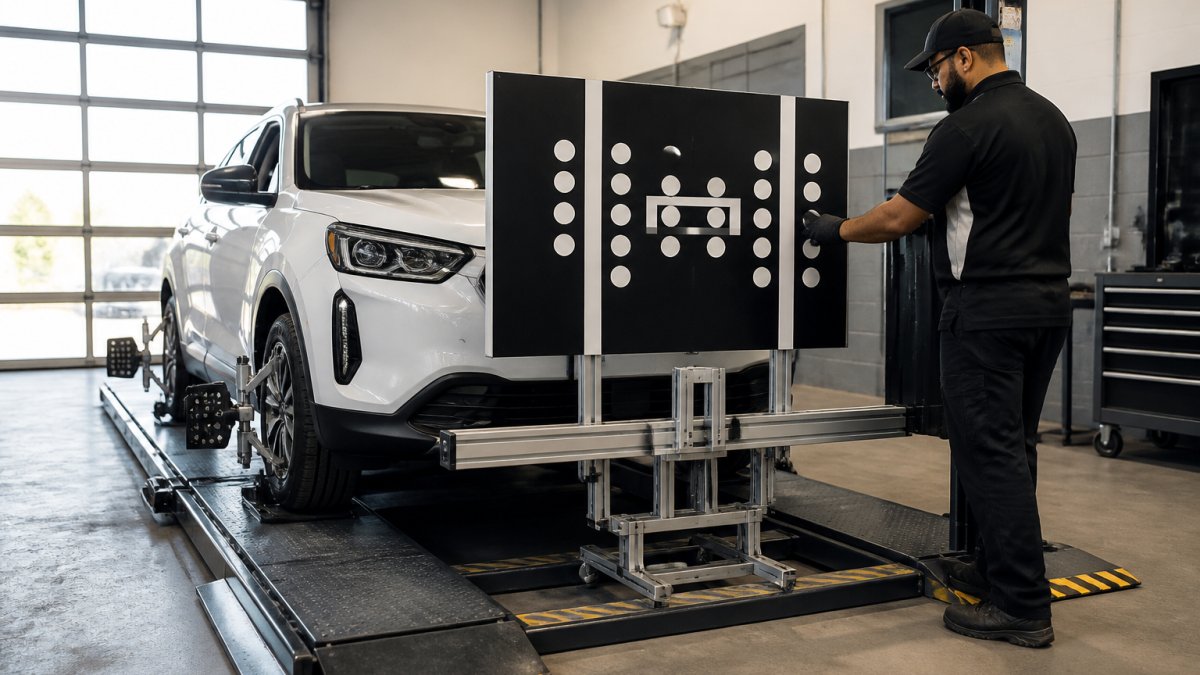
Shops that can name their I-CAR, ASE, OEM, and equipment-vendor credentials, show you the calibration bay, and hand over a written calibration report are your best bet. Those three things, named credentials, visible equipment, and documentation, are hard to fake and easy to verify.
Getting Started With Your Calibration Service
Contact Titan Auto Glass to discuss your specific situation. Whether you need calibration after windshield replacement, collision repair, or you’re experiencing ADAS warning lights, our certified technicians can evaluate your vehicle and recommend the right approach.
When you call, have your vehicle’s year, make, and model ready. This helps us determine what ADAS systems your vehicle has and what calibration process it requires.
We’ll discuss timing, pricing, insurance coverage, and warranty details. You’ll know exactly what to expect before we begin. Titan Auto Glass accepts all insurance and offers warranty coverage for up to 1 year.
Your vehicle’s safety systems are too important to leave to chance. Certified ADAS calibration shops DFW like Titan Auto Glass combine technical expertise with the right equipment to ensure your safety features work exactly as designed.
Modern vehicles depend on ADAS systems to prevent collisions and protect lives. When your windshield is replaced or your vehicle is damaged, those systems need professional recalibration to function correctly.
Frequently Asked Questions
Do you need ADAS calibration after windshield replacement?
Yes. When a windshield is replaced, the camera and sensors mounted behind or near the glass can shift slightly, even by fractions of an inch. This affects how your advanced driver assistance systems detect road hazards, lane markings, and other vehicles. Recalibration ensures your safety features work as the manufacturer designed them. Without it, collision avoidance and lane-keeping systems may fail to respond correctly.
How can I verify that an ADAS calibration shop is certified?
Ask for documentation of technician certifications from vehicle manufacturers or industry bodies. Certified shops display credentials from various manufacturers. Request proof that their equipment meets OE (original equipment) standards and that they follow manufacturer-specific calibration procedures. Reputable shops provide written verification of completed calibration and often include it with your warranty documentation.
Can ADAS calibration be done mobile?
Some shops offer mobile ADAS calibration services, where technicians come to your location. However, static calibration (the most common type) typically requires the vehicle to be on a level surface with specific equipment. Dynamic calibration, performed while driving, may be available through select providers. Ask whether the shop offers mobile service and whether it meets your vehicle manufacturer’s requirements for accuracy and documentation.
How long does ADAS calibration take?
Static calibration typically takes time, depending on your vehicle’s system complexity and the number of sensors requiring adjustment. Dynamic calibration may take longer and involves a test drive. Some shops can complete the work while you wait; others may require an appointment. Turnaround time also depends on whether your vehicle requires calibration of cameras, radar, or both systems.