
Table of Contents
- Why Verifying a Glass Technician Matters for Your Safety
- How to Check Auto Glass Technician Certification Step by Step
- Questions to Ask an Auto Glass Technician Before Work Begins
- How to Confirm ADAS Windshield Calibration Verification Was Done Correctly
- What a Windshield Installation Warranty Should Cover
- Booking Your Windshield Job With Titan Auto Glass
- Frequently Asked Questions
Last Updated: November 10, 2026
Why Verifying a Glass Technician Matters for Your Safety
Your windshield is a safety part, not just a window. In a crash, it helps hold the roof in place and supports the airbags. A poor install can leak, whistle at highway speed, or let the glass pop loose. That is why it pays to verify glass technician credentials before you book, not after the work is done.
Start with a simple rule. Confirm the shop and the tech before you hand over your keys. Most problems trace back to a rushed install or a crew that never got proper training. We recommend checking credentials first, then asking for proof of the work.
Modern cars add another layer. If your vehicle has lane-keeping, automatic braking, or adaptive cruise control, the camera behind the windshield must be recalibrated after replacement. Skipping that step can leave those safety features working wrong.
How to Check Auto Glass Technician Certification Step by Step
Certification tells you a technician has been trained and tested on proper install methods. But a logo on a van or a line on a website is not proof. To verify glass technician credentials for an individual, it takes about ten minutes if you know what to ask for and where to look. Work through these steps in order.
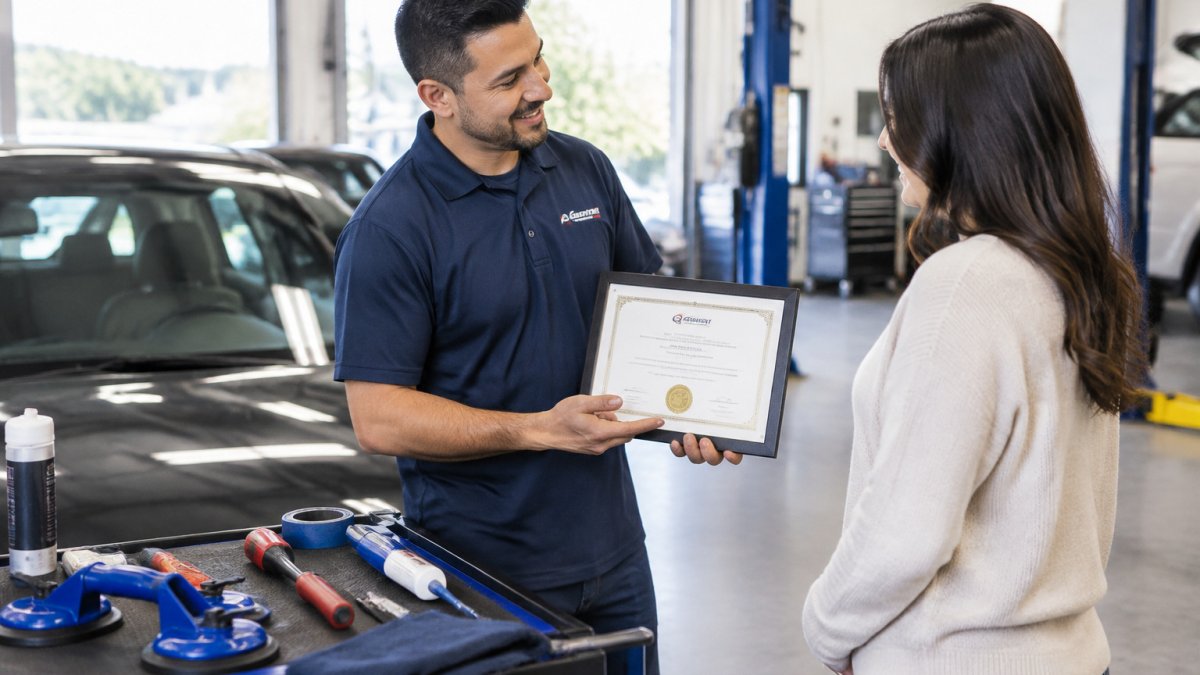
- Ask for the technician’s full name and the name of the certifying body that issued the credential. Write both down.
- Ask for the certification number or credential ID, not just the program name.
- Check the certifying body’s public directory or verification portal, if one exists, and confirm the name and number match.
- Confirm the credential is current, ask for the expiration or renewal date and check it against today’s date.
- Ask whether the credential covers the type of work being done (repair versus replacement, and whether ADAS recalibration is included).
- Confirm the shop’s business license and insurance separately from the technician’s credential.
- Ask whether the shop uses OEM or OEM-equivalent glass and request the warranty terms in writing before you book.
A good shop will answer these questions without hesitation. If a shop dodges, treat that as a warning sign.
Distinguishing a Technician Credential From a Shop Credential
This is where most customers get confused. A shop can hold a business-level registration or network affiliation while the individual doing the install holds no personal certification, or the reverse. Ask specifically: “Is the person installing my glass personally certified, and can I see that credential?” A company certificate on the wall does not transfer to the technician holding the caulk gun.
Watch out: some shops display a program logo that reflects a manufacturer network partnership rather than a technician certification. Ask which one you are looking at.
Confirming Company and Shop Credentials
Company credentials matter as much as the individual technician. Ask for the shop’s legal name and check it against your state’s business records. Then confirm the shop carries liability and garage-keepers insurance, ask for a certificate of insurance, not just a verbal yes.
Ask which manufacturer network the shop belongs to, if any. Titan’s certified Ford Auto Glass Network partner status is one example of a network credential to check.
Checking Technician Training and Qualifications
Training is where skill gaps show up. Ask how long the technician has installed glass and whether they have completed recent training on your vehicle’s glass and camera systems. A technician who has worked on your model before is a better bet.
Ask what the credential does and does not prove. Certification confirms training and testing at a point in time; it does not guarantee workmanship on every job, and it does not replace the shop’s warranty. A current credential plus a clear written warranty is a stronger signal than either one alone.
Watch out for these red flags:
- No clear answer about training or credential number
- Pressure to decide on the spot
- Vague answers about who will do the install
- A credential that cannot be looked up or has lapsed
The steps below summarise how to check a technician’s credentials, and what each step should confirm.
| Step | What to do | What it confirms |
|---|---|---|
| 1 | Ask for the technician’s full name and certifying body | Who was trained |
| 2 | Request the certification or credential ID | A specific, checkable credential |
| 3 | Check the certifying body’s public directory | Name and number match |
| 4 | Check the expiration or renewal date | Credential is current |
| 5 | Confirm the credential covers your work type | Repair, replacement or ADAS |
| 6 | Verify shop business license and insurance | Shop is legitimate and covered |
| 7 | Request warranty terms in writing | Coverage is documented |
Questions to Ask an Auto Glass Technician Before Work Begins
Use these questions to get clear answers before the job starts:
- Are you certified for this specific vehicle type?
- Will you perform the ADAS recalibration, or send me elsewhere?
- What urethane and adhesive do you use, and how long before the car is safe to drive?
- Do you check fit and seal before you hand the car back?
- What does my warranty cover, and for how long?
Write the answers down. If anything changes on the day of the job, you have a record to point to.
How to Confirm ADAS Windshield Calibration Verification Was Done Correctly
Calibration is the step most often skipped, and it is the one that matters most for modern vehicles. The camera behind the windshield must be aligned to the manufacturer’s specifications after the new glass is in. A shop that tells you calibration is “not needed” for your car should be questioned, and asked to show you the manufacturer’s procedure for your VIN.
Calibration is typically required when the windshield is replaced, when the camera is removed or repositioned, when ride height changes, or when the manufacturer’s procedure calls for it after glass work. Read why ADAS re-calibration matters after a new windshield to see the reasons it is needed. Static calibration uses a target placed in front of the vehicle in a controlled space; dynamic calibration requires driving the vehicle under specified conditions. Ask which method your vehicle needs and whether the shop can perform it in-house or sends it out.
Calibration Proof and Records to Request
Request these documents before you leave the shop:
- A printed or emailed calibration report showing pass or fail for each system
- The pre-scan and post-scan results, so you can see what codes were present before and after
- The calibration method used (static or dynamic) and the target or drive conditions
- The technician’s name and the date and time of calibration
- The vehicle’s VIN on the report
- Confirmation that no diagnostic trouble codes remain after the procedure
Keep these records with your vehicle paperwork. If a warning light appears later, you can show exactly what was done and when.
How to Confirm the Work Was Actually Done
A report is only useful if it matches your car. Check that the VIN on the report matches your vehicle, that the date matches your appointment, and that the systems listed match the features your car actually has. If your vehicle has lane-keeping, automatic braking, or adaptive cruise control, those systems should appear on the scan.
After you drive away, watch for a persistent warning light, a message that a system is unavailable, or a camera view that looks misaligned. Any of these is a reason to return and ask for a re-scan. A shop that stands behind its calibration will re-check it without argument.
Watch out: a report that lists only “calibration complete” with no system-by-system results and no VIN is not proof. Ask for the full scan output.
What a Windshield Installation Warranty Should Cover
A warranty should cover more than the glass itself. Read the terms for workmanship, leaks, wind noise, and defects in the seal. Ask how long each one lasts and what you must do to keep the coverage valid.
Titan Auto Glass offers warranty coverage for up to 1 year. Ask for the full written terms so you know exactly what is included, and what would void it.
Booking Your Windshield Job With Titan Auto Glass
Once you have verified the technician, the shop, and the calibration plan, you are ready to book. Titan Auto Glass is a family-owned and operated business serving the DFW area, with certified technicians and ADAS recalibration services.
Request a quote for your repair or replacement. Ask for the calibration report and warranty terms in writing before the work starts. Booking with a shop that answers every question clearly is the surest way to protect your safety.
When you are ready, you can request a quote from Titan Auto Glass.
Frequently Asked Questions
How do I know a glass technician is certified for ADAS recalibration?
Ask the shop which technician performs calibrations and request the credential or training record for that person, not just a company logo. Confirm the shop documents calibration procedures for your specific vehicle. Titan Auto Glass uses certified technicians, and you can ask for credential information before the job begins.
What questions should I ask an auto glass technician before booking?
Ask whether the technician is certified, whether the shop calibrates ADAS in-house or refers it out, what glass brand and adhesive they use, and what the installation warranty covers. Also ask how long the urethane needs to cure before you drive, and whether they will provide written documentation after the job. Clear answers to these questions show whether the shop can handle your vehicle properly.
Does a windshield installation warranty cover leaks and wind noise?
A solid warranty should explicitly cover water leaks, wind noise caused by improper sealing, and defects in workmanship for a stated period. Titan Auto Glass offers warranty coverage for up to 1 year, so ask for the written terms and confirm what is excluded. Keep your invoice and warranty paperwork together for any future claim.
Will my insurance cover windshield replacement and ADAS recalibration?
Many comprehensive auto insurance policies cover windshield replacement, though your deductible and policy terms determine what you pay out of pocket. ADAS recalibration is often billed separately, so ask the shop to itemize the glass, labor, and calibration charges before work starts. Titan Auto Glass accepts all insurance.
