
Last Updated: November 14, 2026
Quick Summary
The best auto glass for safety is laminated windshield glass that is verified against its manufacturer markings and part number, installed with a proper adhesive bond, and recalibrated if your vehicle has driver assistance cameras. The windshield supports airbags and holds the roof structure in a crash, so the glass type and installation both matter.
- Windshields must be laminated glass, which holds together when cracked and supports airbag deployment.
- Confirm the part number and manufacturer before installation, and check the etched corner marking afterward.
- Ask whether the part includes the original camera bracket, rain sensor, and acoustic or solar features.
- Vehicles with ADAS cameras may need recalibration after the glass is replaced.
- Keep the invoice and part number for your records and any insurance claim.
Table of Contents
- Why Windshield Glass Matters for Crash Protection and Airbags
- Laminated vs. Tempered Glass: How Auto Glass Is Built
- OEM vs aftermarket windshield: Comparing Quality, Fit, and Clarity
- Windshield Safety Standards and How to Verify a Replacement
- Windshield Replacement and ADAS Recalibration Explained
- Windshield Replacement Checklist for DFW Drivers
- Booking Your Safety-Focused Windshield Replacement with Titan Auto Glass
- Frequently Asked Questions
Why Windshield Glass Matters for Crash Protection and Airbags
The windshield does far more than keep wind and rain out of the cabin. In a crash, it helps hold the roof structure in place and gives the front airbags a surface to press against. When the glass is the wrong type, or is installed poorly, that job gets harder.
Many drivers assume any clear pane will do. In practice, the glass has to meet specific construction and fitment requirements, and the bond holding it to the frame has to cure properly. A windshield that looks fine can still underperform in a collision.
Laminated vs. Tempered Glass: How Auto Glass Is Built
Windshields are laminated glass: two layers of glass bonded around a plastic interlayer, usually polyvinyl butyral. When the glass cracks, the interlayer holds the fragments in place. That is why a damaged windshield stays intact instead of shattering into the cabin.
Side and rear windows are typically tempered glass. Tempered glass is heat-treated to break into small, blunt pieces when it fails. That design reduces injury from flying shards, but it also means tempered glass cannot be used in the windshield position, where the structural and airbag-support roles matter most.
- Laminated glass (windshield): Holds together when cracked, supports airbag deployment, resists penetration.
- Tempered glass (side and rear): Breaks into small pieces, lighter impact resistance, used where visibility demands are lower.
OEM vs aftermarket windshield: Comparing Quality, Fit, and Clarity
Original equipment manufacturer (OEM) glass is made to the vehicle maker’s specifications and is often, but not always, the same part that came on the car at the factory. OEM-equivalent glass is produced by a different manufacturer to meet the same specifications. Aftermarket glass covers a wider range, from products that closely match OEM dimensions to lower-cost pieces with less consistent curvature and optics. The category label alone tells you little; what matters is whether the specific part meets the specifications your vehicle needs.
What actually differs between the three categories
- Fit and curvature: The glass must match the vehicle’s opening, roofline, and cowl. Poor fit shows up as wind noise, water leaks, stress cracks at the edges, and a bond that never fully seats. Fit is a function of tooling and quality control, not of the category name.
- Optical clarity and distortion: Look through the glass at a straight vertical line (a light pole or door frame) from several angles. Waviness or bending in the line indicates distortion. Distortion matters more on vehicles with camera-based driver assistance, because the camera looks through the glass.
- Light transmission: Windshields must pass enough visible light to meet applicable standards. Ask for the light-transmission rating of the specific part, not the category.
- Acoustic and solar properties: Many vehicles use acoustic laminated glass or solar-control glass on certain trims. A replacement that lacks these features can be louder or hotter than the original even if it fits.
- Certification markings: Every safety glazing part sold for highway use should carry the manufacturer’s mark and an indication that it meets the applicable federal glazing standard. A part with no readable marking is a red flag.
How to verify a part before you accept the install
- Ask the shop to identify the exact part number and manufacturer before the appointment.
- When the old glass is out, look at the etched corner marking on the new glass. It should identify the manufacturer and indicate safety glazing.
- Confirm the glass is laminated, not tempered, for the windshield position.
- Ask whether the part includes the same features as the original (acoustic interlayer, solar coating, antenna, rain sensor bracket, camera bracket).
- Get the part category and part number in writing on the invoice.
Watch out: a shop that cannot or will not tell you the manufacturer and part number before installation is asking you to accept whatever arrives on the truck.
Cost, insurance, and warranty: the decision framework
Pricing for each glass category depends on the vehicle, glass type, and availability. Request a current quote for your specific car.
Insurance handling depends on your policy. Confirm your coverage and deductible with your insurer before scheduling. Confirm with your insurer whether the claim uses OEM, OEM-equivalent, or aftermarket parts and whether you have the right to request a specific category.
Warranty is where categories converge. What protects you is the workmanship warranty on the installation, the adhesive bond, water tightness, and recalibration, not just the glass manufacturer’s warranty.
Quick comparison
| Factor | OEM | OEM-equivalent | Aftermarket |
|---|---|---|---|
| Matches original specifications | Yes | Built to same specs | Varies by manufacturer |
| Fit and optics consistency | Typically highest | Usually strong | Widest range |
| Cost | Usually highest | Mid-range | Usually lowest |
| Availability | Varies by model | Broad | Broadest |
| Verification needed | Confirm part number | Confirm source and markings | Confirm markings and features |
| Workmanship warranty | Shop-dependent | Shop-dependent | Shop-dependent |
The right choice depends on your vehicle, its features, your insurance, and how long you plan to keep the car. The category is a starting point; the verified part number and the installer’s workmanship are what determine safety.
Windshield Safety Standards and How to Verify a Replacement
In the United States, automotive glazing is governed by Federal Motor Vehicle Safety Standard 205 (FMVSS 205), which sets performance requirements for glazing materials, including light transmission, fragmentation behavior, and penetration resistance. FMVSS 205 incorporates by reference several industry standards, including SAE and ANSI/SAE glazing standards, which define test methods and marking requirements. You can review the standard and its incorporated references through the NHTSA Federal Motor Vehicle Safety Standards glazing requirements.
What the standard actually requires
FMVSS 205 does not certify a brand or a shop; it sets performance requirements that a glazing part must meet. For a step-by-step guide to checking a technician before you book, see how to verify a glass technician before booking. For a windshield, the practical requirements are:
- Laminated construction: The windshield must be laminated so it holds together when broken and provides a surface for airbag deployment.
- Light transmission: The windshield must transmit at least the minimum visible light required by the standard. Tint, coatings, and aftermarket films can affect this.
- Penetration resistance: The glass must resist penetration under the standard’s test conditions.
- Marking: Each part must carry the manufacturer’s mark and an indication that it meets the applicable standard, so the part can be traced.
How to verify a replacement before and after installation
- Ask for the part number and manufacturer in advance. A reputable shop can tell you what will be installed before the appointment.
- Read the etched corner marking. Look for the manufacturer’s name or code, the standard mark (often shown as “DOT” followed by a manufacturer code, or an “AS1” designation for windshield glazing), and a laminated-glass indication. If the marking is missing, illegible, or inconsistent with the invoice, stop and ask.
- Confirm the glass is laminated, not tempered. Tempered glass belongs in side and rear positions, not the windshield.
- Ask for the light-transmission rating of the specific part and confirm it meets the standard for your vehicle.
- Confirm the part includes the features your vehicle needs, camera bracket, rain sensor, acoustic interlayer, antenna, or solar coating, because a part that fits but lacks these features is not equivalent to the original.
- Keep the invoice and part number for your records and your insurance claim.
Watch out: a marking that reads “AS1” indicates windshield glazing, but it does not by itself prove the part meets every requirement for your specific vehicle. The marking is a starting point, not a substitute for confirming the part number and features.
What to ask the installer
- Which standard does this part meet, and where is the marking?
- Is the glass laminated, and what is its light-transmission rating?
- Does the part include the same features as the original (camera bracket, acoustic layer, solar coating)?
- Will you document the part number and manufacturer on the invoice?
- Does your workmanship warranty cover the bond, leaks, and recalibration?
Windshield Replacement and ADAS Recalibration Explained
Many newer vehicles mount forward-facing cameras and sensors behind the windshield. These support features such as lane-keeping, automatic emergency braking, and adaptive cruise control. Advanced Driver Assistance Systems (ADAS) depend on precise sensor alignment, so replacing the glass can require recalibration.
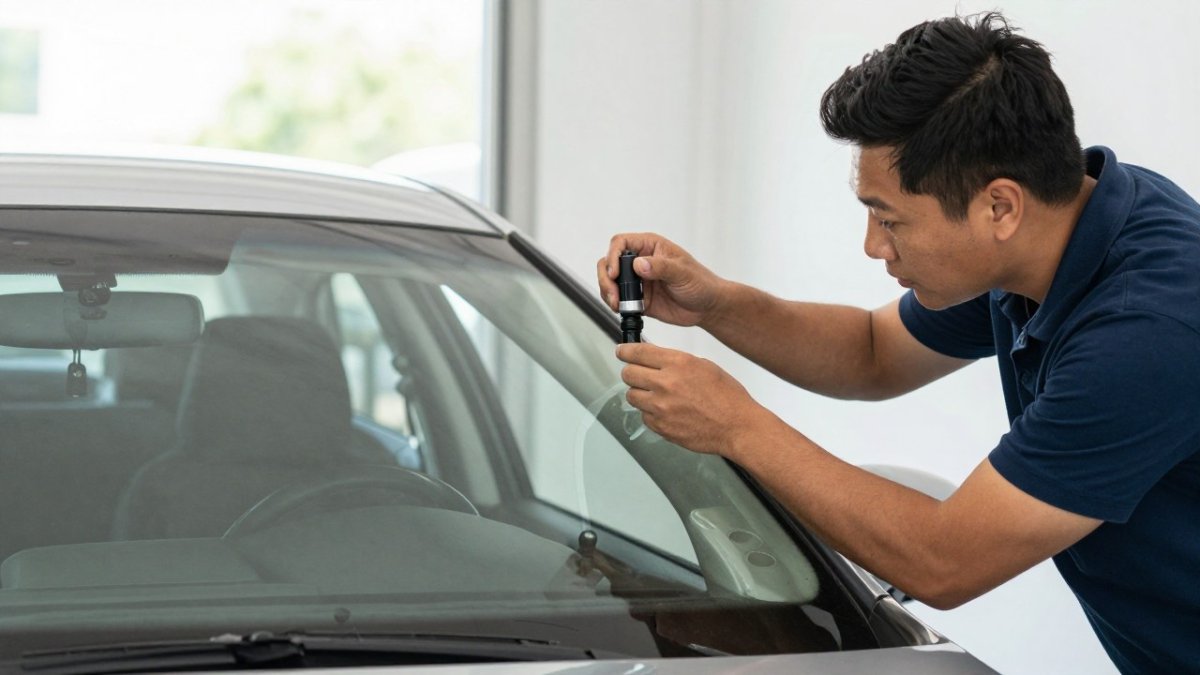
Calibration may be static, performed with targets in a controlled setup, or dynamic, performed by driving under specific conditions. For drivers who want a local option, our ADAS recalibration information from the National Highway Traffic Safety Administration research is a useful starting point, and our ADAS re-calibration service in McKinney explains the process for McKinney drivers.
For a detailed look at what the calibration process involves, read our ADAS recalibration process guide.
Windshield Replacement Checklist for DFW Drivers
Use this checklist before and after any windshield replacement:
- Confirm the glass type (OEM, OEM-equivalent, or aftermarket) and get it in writing.
- Verify the glass is laminated and carries the manufacturer markings.
- Ask for the light-transmission rating.
- Check whether your vehicle has ADAS and whether recalibration is included.
- Confirm the adhesive and cure time before driving.
- Ask about the warranty terms; Titan Auto Glass covers workmanship for up to 1 year.
- Keep documentation for your insurance claim.
Insurance deductibles vary by policy, so confirm your coverage before scheduling. Pricing depends on the vehicle, glass type, and whether ADAS recalibration is needed, so request a current quote for your specific car.
Booking Your Safety-Focused Windshield Replacement with Titan Auto Glass
Titan Auto Glass is a family-owned and operated business serving the DFW area. We work with certified technicians, use quality parts and adhesives, and accept all insurance.
If your windshield is cracked, chipped, or your vehicle has driver assistance features that need checking, request a quote from Titan Auto Glass or visit our windshield replacement service page to learn what we offer. Choosing the best auto glass for safety comes down to verified parts, correct installation, and proper recalibration. We are ready to handle all three for you.
Frequently Asked Questions
Is OEM glass safer than aftermarket glass?
OEM glass is made to the vehicle manufacturer’s specifications, and OEM-equivalent glass is designed to match them. Both must meet the Federal Motor Vehicle Safety Standard (FMVSS) 205 requirements for glazing materials in the United States. The practical safety difference usually comes down to fit, optical clarity, and whether the installer uses correct adhesives and follows the vehicle’s procedures. Ask whether the glass carries the DOT marking and whether the shop can confirm the part number matches your vehicle. Request a quote from Titan Auto Glass to discuss options for your specific vehicle.
Does a replacement windshield need ADAS recalibration?
Many modern vehicles require ADAS recalibration after windshield replacement because forward-facing cameras are typically mounted to the glass. If the camera is not aligned, lane-keeping, automatic emergency braking, and adaptive cruise control may not work correctly. Recalibration can be static, dynamic, or a combination, depending on the manufacturer. Titan Auto Glass uses certified technicians for ADAS re-calibration, so confirm with the shop whether your vehicle needs it before the job is scheduled.
How can I tell if replacement auto glass meets safety standards?
Look for the DOT marking etched into the glass, which indicates compliance with U.S. federal motor vehicle glazing standards. Ask the installer which glass type they are using, whether it is laminated (windshields are laminated in the United States), and whether the adhesive and urethane system matches the manufacturer’s recommendations. A reputable shop will show you the part label and explain the installation procedure. Request a quote from Titan Auto Glass to discuss your options.
Is laminated glass safer than tempered glass for a windshield?
Yes. Laminated glass, which bonds a plastic interlayer between two sheets of glass, holds together when cracked and keeps the vehicle sealed, which supports airbag deployment and occupant protection in a crash. Tempered glass shatters into small pieces and is used for side and rear windows, not windshields. When choosing replacement glass, confirm that the windshield is laminated.
